
NSSegmentedControl Class Reference
| Inherits from | |
| Conforms to | |
| Framework | /System/Library/Frameworks/AppKit.framework |
| Availability | Available in Mac OS X v10.3 and later. |
| Companion guide | |
| Declared in | NSSegmentedControl.h |
| Related sample code |
Overview
An NSSegmentedControl object implements a horizontal button made of multiple segments.
The NSSegmentedControl class uses an NSSegmentedCell class to implement much of the control's functionality. Most methods in NSSegmentedControl are simply "cover methods” that call the corresponding method in NSSegmentedCell. The methods of NSSegmentedCell that do not have covers relate to accessing and setting values for tags and tool tips; programatically setting the key segment; and establishing the mode of the control.
The features of a segmented control include:
Each segment can have an image, text (label), menu, tooltip, and tag
Either the whole control or individual segments can be enabled or disabled
There are three tracking modes for segments: select one mode (also known as radio button mode and illustrated by Finder’s view mode selection control), momentary mode (as illustrated by Safari’s toolbar buttons), or select any mode (where any combination of buttons may be on or off)
Each segment can be either a fixed width or autosized to fit the contents
If a segment has text and is marked as autosizing, then the text may be truncated so that the control completely fits
If an image is too large to fit in a segment, it is clipped
Full keyboard control of the user interface
Tasks
Specifying Number of Segments
Specifying Selected Segment
Working with Individual Segments
-
– setWidth:forSegment:
-
– widthForSegment:
-
– setImage:forSegment:
-
– imageForSegment:
-
– setLabel:forSegment:
-
– labelForSegment:
-
– setMenu:forSegment:
-
– menuForSegment:
-
– setSelected:forSegment:
-
– isSelectedForSegment:
-
– setEnabled:forSegment:
-
– isEnabledForSegment:
Specifying Segment Display
Instance Methods
imageForSegment:
Returns the image associated with the specified segment.
- (NSImage *)imageForSegment:(NSInteger)segment
Parameters
- segment
The index of the segment whose image you want to get. This method raises an
NSRangeExceptionif the index is out of bounds.
Return Value
The image associated with the segment; otherwise, nil.
Availability
- Available in Mac OS X v10.3 and later.
See Also
Declared In
NSSegmentedControl.himageScalingForSegment:
Returns the scaling mode used to display the specified segment’s image.
- (NSImageScaling)imageScalingForSegment:(NSInteger)segment
Parameters
- segment
The index of the segment whose enabled state you want to get. This method raises an
NSRangeExceptionif the index is out of bounds.
Return Value
One of the image scaling constants. For a list of possible values, see NSImageScaling. The default value is NSImageScaleProportionallyDown.
Availability
- Available in Mac OS X v10.5 and later.
See Also
Declared In
NSSegmentedControl.hisEnabledForSegment:
Returns a Boolean value indicating whether the specified segment is enabled.
- (BOOL)isEnabledForSegment:(NSInteger)segment
Parameters
- segment
The index of the segment whose enabled state you want to get. This method raises an
NSRangeExceptionif the index is out of bounds.
Return Value
YES if the segment is enabled; otherwise, NO.
Availability
- Available in Mac OS X v10.3 and later.
See Also
Declared In
NSSegmentedControl.hisSelectedForSegment:
Returns a Boolean value indicating whether the specified segment is selected.
- (BOOL)isSelectedForSegment:(NSInteger)segment
Parameters
- segment
The index of the segment whose selection state you want to get. This method raises an
NSRangeExceptionif the index is out of bounds.
Return Value
YES if the segment is selected; otherwise, NO.
Availability
- Available in Mac OS X v10.3 and later.
See Also
Declared In
NSSegmentedControl.hlabelForSegment:
Returns the label of the specified segment
- (NSString *)labelForSegment:(NSInteger)segment
Parameters
- segment
The index of the segment whose label you want to get. This method raises an
NSRangeExceptionif the index is out of bounds.
Return Value
The label of the segment. The returned string contains the entire text of the label, even if that text is normally truncated during drawing.
Availability
- Available in Mac OS X v10.3 and later.
See Also
Declared In
NSSegmentedControl.hmenuForSegment:
Returns the menu for the specified segment
- (NSMenu *)menuForSegment:(NSInteger)segment
Parameters
- segment
The index of the segment whose menu you want to get. This method raises an
NSRangeExceptionif the index is out of bounds.
Return Value
The menu associated with the segment; otherwise, nil.
Availability
- Available in Mac OS X v10.3 and later.
See Also
Declared In
NSSegmentedControl.hsegmentCount
Returns the number of segments in the receiver.
- (NSInteger)segmentCount
Return Value
The number of segments.
Availability
- Available in Mac OS X v10.3 and later.
See Also
Declared In
NSSegmentedControl.hsegmentStyle
Returns the visual style used to display the receiver.
- (NSSegmentStyle)segmentStyle
Return Value
An NSSegmentStyle value that specifies the visual display used by the receiver. For possible values see “Segmented Control Visual Styles.”
Availability
- Available in Mac OS X v10.5 and later.
See Also
Declared In
NSSegmentedControl.hselectedSegment
Returns the index of the selected segment of the receiver.
- (NSInteger)selectedSegment
Return Value
The index of the currently selected segment or -1 if no segment is selected. If the receiver allows multiple selections, this method returns the most recently selected segment.
Availability
- Available in Mac OS X v10.3 and later.
See Also
Related Sample Code
Declared In
NSSegmentedControl.hselectSegmentWithTag:
Selects the segment with the specified tag.
- (BOOL)selectSegmentWithTag:(NSInteger)tag
Parameters
- tag
The tag associated with the desired segment.
Return Value
YES if the segment was selected successfully; otherwise, NO.
Discussion
Typically, you use Interface Builder to specify the tag for each segment. You may also set this value programmatically using the setTag:forSegment: method of NSSegmentedCell.
Availability
- Available in Mac OS X v10.4 and later.
See Also
-
– setTag:forSegment:(NSSegmentedCell)
Declared In
NSSegmentedControl.hsetEnabled:forSegment:
Sets the enabled state of the specified segment
- (void)setEnabled:(BOOL)flag forSegment:(NSInteger)segment
Parameters
- flag
YESto enable the segment; otherwise,NOto disable it.- segment
The index of the segment you want to enable or disable. This method raises an
NSRangeExceptionif the index is out of bounds.
Availability
- Available in Mac OS X v10.3 and later.
See Also
Declared In
NSSegmentedControl.hsetImage:forSegment:
Sets the image for the specified segment.
- (void)setImage:(NSImage *)image forSegment:(NSInteger)segment
Parameters
- image
The image to apply to the segment or
nilif you want to clear the existing image. Images are not scaled to fit inside a segment. If the image is larger than the available space, it is clipped.- segment
The index of the segment whose image you want to set. This method raises an
NSRangeExceptionif the index is out of bounds.
Availability
- Available in Mac OS X v10.3 and later.
See Also
Declared In
NSSegmentedControl.hsetImageScaling:forSegment:
Sets the scaling mode used to display the specified segment’s image.
- (void)setImageScaling:(NSImageScaling)scaling forSegment:(NSInteger)segment
Parameters
- scaling
One of the image scaling constants. For a list of possible values, see
NSImageScaling.- segment
The index of the segment whose enabled state you want to get. This method raises an
NSRangeExceptionif the index is out of bounds.
Availability
- Available in Mac OS X v10.5 and later.
See Also
Declared In
NSSegmentedControl.hsetLabel:forSegment:
Sets the label for the specified segment.
- (void)setLabel:(NSString *)label forSegment:(NSInteger)segment
Parameters
- label
The label you want to display in the segment. If the width of the string is greater than the width of the segment, the string's text is truncated during drawing.
- segment
The index of the segment whose label you want to set. This method raises an
NSRangeExceptionif the index is out of bounds.
Availability
- Available in Mac OS X v10.3 and later.
See Also
Declared In
NSSegmentedControl.hsetMenu:forSegment:
Sets the menu for the specified segment.
- (void)setMenu:(NSMenu *)menu forSegment:(NSInteger)segment
Parameters
- menu
The menu you want to add to the segment or
nilto clear the current menu. This menu is displayed when the user clicks and holds the mouse button while the mouse is over the segment.- segment
The index of the segment whose menu you want to set. This method raises an
NSRangeExceptionif the index is out of bounds.
Discussion
Adding a menu to a segment allows that segment to be used as a pop-up button.
Availability
- Available in Mac OS X v10.3 and later.
See Also
Declared In
NSSegmentedControl.hsetSegmentCount:
Sets the number of segments in the receiver.
- (void)setSegmentCount:(NSInteger)count
Parameters
- count
The number of segments the receiver should have. If this value is less than the number of segments currently in the receiver, segments are removed from the right of the control. Similarly, if the number is greater than the current number of segments, the new segments are added on the right. This value must be between
0and2049.
Availability
- Available in Mac OS X v10.3 and later.
See Also
Declared In
NSSegmentedControl.hsetSegmentStyle:
Sets the visual style used to display the receiver.
- (void)setSegmentStyle:(NSSegmentStyle)segmentStyle
Parameters
- segmentStyle
An
NSSegmentStylevalue that specifies the visual display used by the receiver. For the possible values see “Segmented Control Visual Styles.”
Discussion
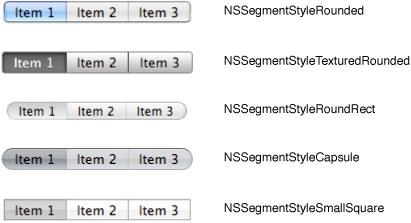
Figure 1 shows the visual styles and their corresponding NSSegmentStyle constant. The NSSegmentStyleAutomatic constant will automatically determined based on the type of window in which the control is displayed and the position within the window., and is not shown in the figure.
Availability
- Available in Mac OS X v10.5 and later.
See Also
Declared In
NSSegmentedControl.hsetSelected:forSegment:
Sets the selection state of the specified segment.
- (void)setSelected:(BOOL)flag forSegment:(NSInteger)segment
Parameters
- flag
YESif you want to select the segment; otherwise,NO.- segment
The index of the segment whose selection state you want to set. This method raises an
NSRangeExceptionif the index is out of bounds.
Discussion
If the receiver allows only a single selection, this method deselects any other selected segments.
Availability
- Available in Mac OS X v10.3 and later.
See Also
Declared In
NSSegmentedControl.hsetSelectedSegment:
Sets the selected segment of the receiver.
- (void)setSelectedSegment:(NSInteger)selectedSegment
Parameters
- selectedSegment
The zero-based index of the desired segment. This method raises an
NSRangeExceptionif the index is out of bounds.
Discussion
If the receiver allows multiple selections, this method selects the specified segment using setSelected:forSegment:.
Availability
- Available in Mac OS X v10.3 and later.
See Also
Declared In
NSSegmentedControl.hsetWidth:forSegment:
Sets the width of the specified segment.
- (void)setWidth:(CGFloat)width forSegment:(NSInteger)segment
Parameters
- width
The width of the segment, measured in points. Specify the value
0if you want the segment to be sized to fit the available space automatically.- segment
The index of the segment whose width you want to set. This method raises an
NSRangeExceptionif the index is out of bounds.
Availability
- Available in Mac OS X v10.3 and later.
See Also
Declared In
NSSegmentedControl.hwidthForSegment:
Returns the width of the specified segment.
- (CGFloat)widthForSegment:(NSInteger)segment
Parameters
- segment
The index of the segment whose width you want to get. This method raises an
NSRangeExceptionif the index is out of bounds.
Return Value
The width of the segment, measured in points, or 0 if the segment is sized to fit the available space automatically.
Availability
- Available in Mac OS X v10.3 and later.
See Also
Declared In
NSSegmentedControl.hConstants
Segmented Control Visual Styles
The following constants specify the visual style used to display the segmented control. They are used by setSegmentStyle:.
enum {
   NSSegmentStyleAutomatic = 0,
   NSSegmentStyleRounded = 1,
   NSSegmentStyleTexturedRounded = 2,
   NSSegmentStyleRoundRect = 3,
   NSSegmentStyleTexturedSquare = 4,
   NSSegmentStyleCapsule = 5,
   NSSegmentStyleSmallSquare = 6
};
typedef NSInteger NSSegmentStyle;
Constants
NSSegmentStyleAutomaticThe appearance of the segmented control is automatically determined based on the type of window in which the control is displayed and the position within the window.
Available in Mac OS X v10.5 and later.
Declared in
NSSegmentedControl.h.NSSegmentStyleRoundedThe control is displayed using the rounded style. See Figure 1 for examples.
Available in Mac OS X v10.5 and later.
Declared in
NSSegmentedControl.h.NSSegmentStyleTexturedRoundedThe control is displayed using the textured rounded style. See Figure 1 for examples.
Available in Mac OS X v10.5 and later.
Declared in
NSSegmentedControl.h.NSSegmentStyleRoundRectThe control is displayed using the round rect style. See Figure 1 for examples.
Available in Mac OS X v10.5 and later.
Declared in
NSSegmentedControl.h.NSSegmentStyleTexturedSquareThe control is displayed using the textured square style. See Figure 1 for examples.
Available in Mac OS X v10.5 and later.
Declared in
NSSegmentedControl.h.NSSegmentStyleCapsuleThe control is displayed using the capsule style. See Figure 1 for examples.
Available in Mac OS X v10.5 and later.
Declared in
NSSegmentedControl.h.NSSegmentStyleSmallSquareThe control is displayed using the small square style. See Figure 1 for examples.
Available in Mac OS X v10.5 and later.
Declared in
NSSegmentedControl.h.
© 2009 Apple Inc. All Rights Reserved. (Last updated: 2009-05-06)